


The second quarter of 2026 reflected a continuation of the crosscurrents that emerged earlier in the year.
The second quarter continued to reinforce the importance of constructing portfolios with multiple return drivers. Public equities recovered from first-quarter weakness, fixed income benefited from stabilized yields, and the private sector showed signs of improving activity.
At the same time, the broader environment was shaped by uncertainty around inflation, Federal Reserve policy, geopolitical risk, and the durability of economic growth. Each asset class carries its own set of opportunities and risks, but together they help provide a more complete view of how we diversify portfolios for optimized positioning in the current and projected environment.
Q2 Equities
Equity markets stabilized during the quarter and delivered mostly positive results across regions and styles.
U.S. Equities
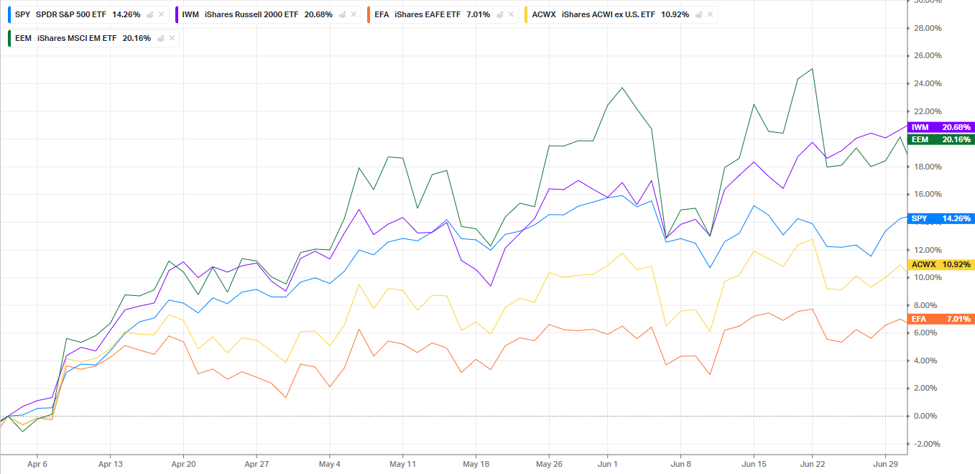
Domestic large‑cap equities, represented by SPY (below), recovered from first quarter declines, but remained range‑bound as investors weighed worsening inflation data against still‑uncertain policy outcomes.
Performance within specific U.S. equity sectors continued to broaden. While large-cap companies regained footing and were up double-digits during the quarter, leadership was less concentrated than in prior years.
Cyclical and value‑oriented sectors saw intermittent strength, particularly during periods of economic optimism, though these gains were not uniform.
Small‑cap stocks, represented by IWM, had excellent performance during the quarter. This run among small-cap stocks is the best H1 since 1991 and is largely driven by the rapid build-out of artificial intelligence infrastructure. The small-cap rally may continue and broaden beyond tech as long as interest rates stay in check.
International Equities
International equity performance was dispersed from modestly positive in developed markets to high outperformance in emerging markets.
Developed markets, represented by EFA, benefited from currency tailwinds and comparatively stable monetary policy expectations, finishing solidly positive.
Emerging markets, represented by EEM, continued their momentum from the first quarter, supported by improving capital flows, stabilizing commodity dynamics, and selective economic strength across key regions. While volatility persisted, the asset class remained one of the stronger performers globally in the first half of the year.
Outlook
The second quarter reinforced a theme that has been gradually building: market leadership is becoming slightly less concentrated and more cyclical. After several years in which a narrow segment of U.S. large‑cap equities dominated returns, leadership is beginning to rotate across sectors, regions, and styles.
While that transition can feel uneven in the short term, it is a constructive development for long‑term investors.
Periods like this often challenge expectations shaped by recent history. However, they also tend to reward diversification and disciplined positioning. Rather than attempting to predict short‑term shifts in leadership, maintaining exposure across a range of return drivers remains the more reliable path to long‑term outcomes.
As in prior quarters, it is important to emphasize that equity markets continue to operate within a longer‑term context of expansion. Short‑term volatility, sector rotation, and periods of consolidation are all consistent with a maturing market cycle and do not, in isolation, signal a structural change in the long‑term growth trajectory.
Q2 Fixed Income
Fixed income markets delivered more stable results in the second quarter compared to the volatility experienced earlier in the year.
Interest Rates & Credit
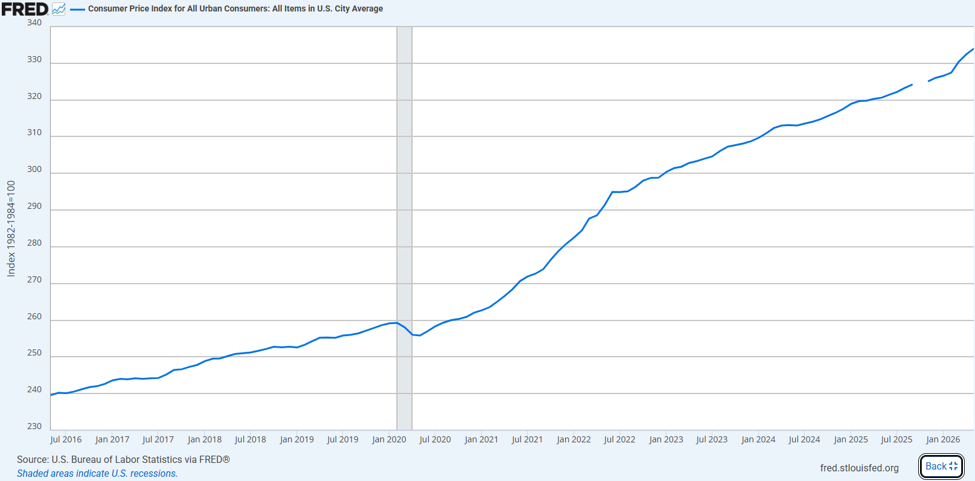
Interest‑rate expectations began to firm as worsening inflation data prompted investors to rethink the possibility of future rate adjustments in 2026.
New Federal Reserve Chairman Kevin Warsh has declined to say whether the central bank needed to consider a rate increase later this year but has stated the risks of higher inflation have receded.
At the same time, yields moved within a narrower range, reducing price volatility across much of the bond market.
Short‑duration and income‑oriented strategies continued to perform consistently, benefiting from elevated starting yields. Credit spreads remained relatively contained, reflecting steady (though not robust) economic conditions.
Municipal Bonds
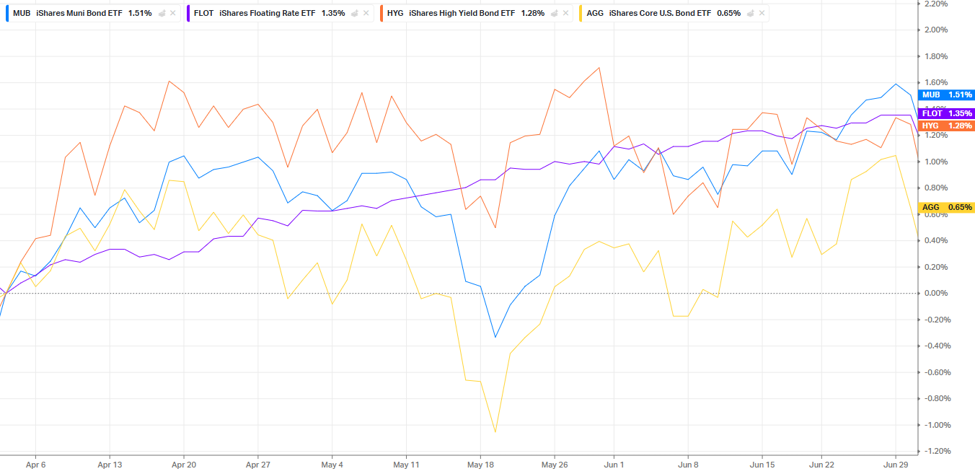
Municipal bonds, represented by MUB in the chart below, recovered from late‑Q1 weakness and produced modest positive returns during Q2. Improved technical demand, combined with attractive tax‑equivalent yields, helped support the asset class.
Longer‑duration bonds experienced periods of both strength and weakness as markets recalibrated expectations for the timing and pace of future rate cuts. While price returns were somewhat uneven, income once again served as the primary contributor to total return.
Outlook
The broader takeaway remains consistent: yields continue to provide a meaningful buffer against volatility. Compared to the low‑rate environment of recent years, today’s starting income levels offer a more reliable foundation for fixed‑income returns, even in the presence of ongoing uncertainty around monetary policy.
Q2 Private Equity
Private equity activity showed steady improvement in the second quarter as market participants gained greater clarity around valuation expectations and financing conditions.
Secondaries
The secondaries market remained a focal point of our strategies, with continued strong deal flow and institutional demand. These transactions provided liquidity solutions in an otherwise constrained exit environment, while also offering opportunities to acquire seasoned assets at negotiated discounts.
Buyouts
Buyout activity increased modestly compared to Q1, particularly for high‑quality assets with resilient cash flows. While financing conditions remained selective, the stability in credit markets helped facilitate transaction activity at more realistic valuation levels than those seen in prior years.
Venture Capital & Growth Equity
Venture capital continued to exhibit a bifurcated environment. Investment activity remained concentrated in artificial intelligence and related infrastructure, while capital for broader early‑stage companies was still limited.
Fundraising conditions across the venture ecosystem remained challenging. Growth equity showed incremental improvement, supported by increased merger and acquisition activity as well as continued expansion of the secondary market as a liquidity mechanism.
Outlook
The IPO market was dominated by SpaceX, which became the largest IPO ever, with a valuation of just under $2 trillion. The backlog of potential issuers continues to build, which may support increased activity once market conditions stabilize further.
From a long‑term perspective, private equity valuations remain meaningfully below their 2021 highs, and the current environment continues to offer attractive entry points for disciplined, selectively deployed capital.
Q2 Private Credit
Private credit remained a meaningful source of income during the second quarter, supported by elevated base rates, continued borrower demand, and the ongoing role of non-bank lenders in financing middle-market companies.
Market Growth & Structural Trends
The asset class continues to benefit from structural growth, despite the recent headlines from various managers. Private markets have become a larger part of how companies finance themselves, and BlackRock notes that slower IPO and M&A activity in recent years has positioned private credit and secondaries as “becoming core to accessing growth and liquidity.”¹
Manager Selectivity
However, the second quarter also highlighted the importance of selectivity. Private credit is not a uniform asset class, and dispersion across managers, borrower types, and deal structures remains significant.
Some areas of the market have faced pressure from higher borrowing costs, weaker asset values, and increased use of payment-in-kind income, particularly among certain publicly traded Business Development Companies (BDCs).
Our long-term view remains steadfast in that private credit can play a valuable income-producing role in diversified portfolios. Recent events reinforce the need to focus on underwriting quality, manager discipline, loan seniority, diversification, and transparency. In an environment where capital is more selective, stronger managers may be able to negotiate better terms, tighter covenants, and more attractive pricing.
Portfolio Construction
Private credit also continues to offer relatively low correlation benefits compared to many traditional asset classes. Private credit possesses lower correlation to global bonds and moderate correlation to global equities, which supports its role as a complementary income-oriented allocation rather than a direct substitute for public fixed income.
Private credit can be useful when accessed thoughtfully, but it should not be viewed as risk-free income. Higher yields come with credit, liquidity, valuation, and manager-selection risk. For long-term investors, the current environment continues to favor disciplined allocations to experienced managers with conservative underwriting standards and strong workout capabilities.
Q2 Real Assets
Real assets delivered a mixed but improving backdrop during the second quarter, with performance and fundamentals varying meaningfully across real estate, infrastructure, and natural-resource-oriented exposures.
Real Estate
Real estate remains in a period of transition. Higher interest rates have pressured valuations over the past several years, particularly in property types with weaker fundamentals or more financing sensitivity. However, the reset in pricing is beginning to create more attractive entry points.
StepStone noted in its Spring 2026 real estate views that current real estate pricing appears near the bottom of the cycle, with dislocation and forced selling creating selective opportunities despite elevated macro uncertainty.²
Sector Opportunities
The opportunity set remains highly segmented. The opportunity set is being reshaped by ongoing capital rotation toward digital infrastructure, logistics, and residential-oriented sectors, with AI-enabled platforms and infrastructure needs.
Infrastructure remains one of the more attractive areas within real assets. The long-term demand for power generation, transmission, data centers, transportation assets, and digital infrastructure continues to be supported by both economic growth and the rapid build-out of artificial intelligence infrastructure.
Infrastructure remains a central theme for most real assets outlooks, with private markets increasingly tied to how societies build infrastructure and how investors diversify portfolios.Direct real estate has historically had a lower correlation to the S&P 500 than public REITs, reinforcing the difference between listed and private real asset exposure.³
Outlook
From a long-term perspective, the case for real assets remains intact. The asset class is not immune from interest-rate pressure or economic weakness, but the combination of repriced valuations, income generation, and structural demand tied to infrastructure and digitalization continues to support our thesis for inclusion in portfolios.
Q2 Macroeconomic Outlook
The macroeconomic backdrop remained resilient but uneven during the second quarter.
Economic Growth
Economic growth continued, though the pace moderated from the post-pandemic expansion period. The Bureau of Economic Analysis reported that real GDP increased at a 2.1% annualized rate in the first quarter of 2026, up from 0.5% in the fourth quarter of 2025.⁴ That improvement was supported by investment, exports, government spending, and consumer spending.
Inflation and Labor Markets
The Federal Reserve remained focused on the balance between growth and inflation. It is important to note that economic activity is expanding at a solid pace despite elevated uncertainty, but inflation remained above the Fed’s 2% goal. Inflation remains a key variable for the second half of the year. The other factor is the labor market, which has remained stable, though less uniformly strong than in prior years.
The writing seems to be on the wall as economists continue to expect a gradual cooling rather than a sharp labor-market downturn.
Outlook
Geopolitical conflict, higher oil prices, and persistent inflation remain risks, but underlying U.S. economic strength has continued, supported by corporate earnings, manufacturing activity, and relatively stable labor markets.
The broader takeaway is the economy remains in expansion, but the margin for error has narrowed. Inflation, policy uncertainty, and geopolitical risk all remain capable of creating renewed volatility.
For long-term investors, the current environment continues to reward balance. Public markets have recovered, private markets are gradually adjusting to more realistic valuations, and income-oriented assets remain more attractive than they were during the low-rate period.
The most appropriate response is not to overreact to any single economic data point, but to maintain a disciplined allocation across multiple return drivers.
Looking Ahead
The second quarter of 2026 reflected a market environment that is improving, but not without risk. Equities stabilized, fixed income benefited from higher starting yields, and private market activity showed signs of normalization.
We maintain the belief that private markets allocations require careful manager selection, thoughtful sizing, and realistic expectations.
As we move into the second half of the year, the focus remains on discipline: staying diversified, maintaining appropriate liquidity, and positioning portfolios around long-term outcomes rather than short-term predictions. Periods of uncertainty are inevitable, but they also reinforce the value of a portfolio built around the needs of each individual investor.
1 2026 Private Markets Outlook | BlackRock | 2 StepStone Real Estate Spring 2026 House Views - StepStone Group | 3 Guide to Alternatives® | 4 GDP (Third Estimate), Industries, Corporate Profits, State GDP, and State Personal Income, 1st Quarter 2026 | U.S. Bureau of Economic Analysis (BEA)
To learn more, contact one of our trusted advisors.