


The first quarter of 2026 marked a meaningful change in market tone.
After several years in which domestic large-cap equities carried much of the return burden, investors entered a more complicated environment shaped by geopolitical tension, an energy-driven inflation shock, and fading expectations for near-term rate cuts.
That combination created weakness in many public-market sectors, but it also reinforced an important truth: the value of diversification, selective positioning, and portfolios built around multiple return drivers, rather than a single market leadership theme, cannot be overstated.
Q1 Equities
Equity markets reversed course from the strong 2025 finish. Domestic equity performance was negative, with large‑cap stocks, represented by SPY (below), declining 4.3%. Much of the weakness was concentrated in growth‑oriented sectors and was most pronounced in March.
Market Performance by Segment
In contrast, small‑cap stocks, represented by IWM, held up better during the quarter and finished positive almost 1%. This quarter marks a second consecutive shift from the prior several years, during which large‑cap stocks consistently outperformed the smaller companies represented in the index.
We continue to not maintain a dedicated small-cap allocation, as our portfolio construction decisions are driven by long-term expected outcomes rather than short-term shifts in market leadership.
International equities rose to start the year and maintained double-digit performance through mid-February but fell near the end of the quarter, similar to the domestic market.
Developed international stocks, represented by EFA, finished above 1% supported by energy exposure and value‑oriented sectors.
Emerging markets, represented by EEM, outpaced all other equity indices at 3.8% with renewed momentum, supported by a combination of macroeconomic tailwinds, some evidence of structural profitability improvements, and strengthening investor sentiment.
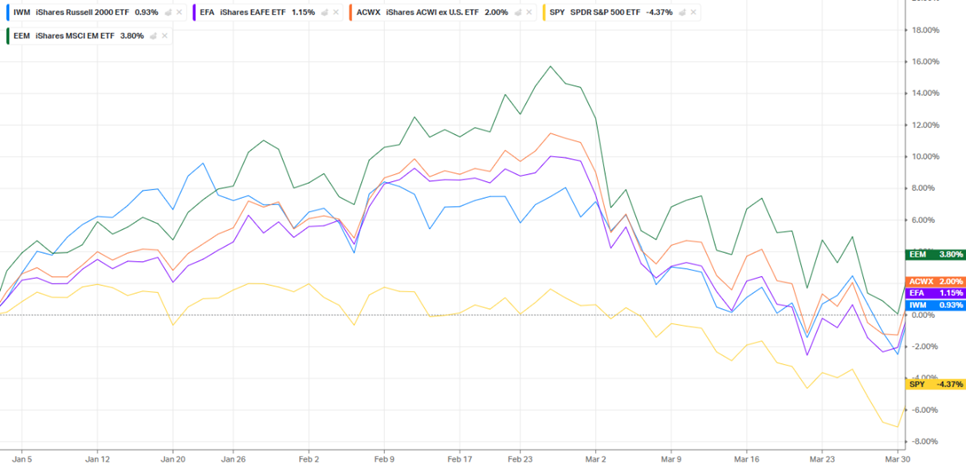
Source: Koyfin; Q1 2026 Time Weighted Returns
Perspective
Despite the weakness in U.S. equities during the quarter, it is important to view recent performance in context. Large‑cap stocks, as represented by the S&P 500 Index, delivered three consecutive years of exceptionally strong returns from 2023 through 2025. Periods of consolidation and pullbacks are a normal and healthy part of long‑term market behavior.
Historically, quarterly declines similar to what we experienced in Q1 are relatively common following multi‑year advances. Markets rarely move in straight lines, and short‑term volatility does not change the long‑term return profile of equities.
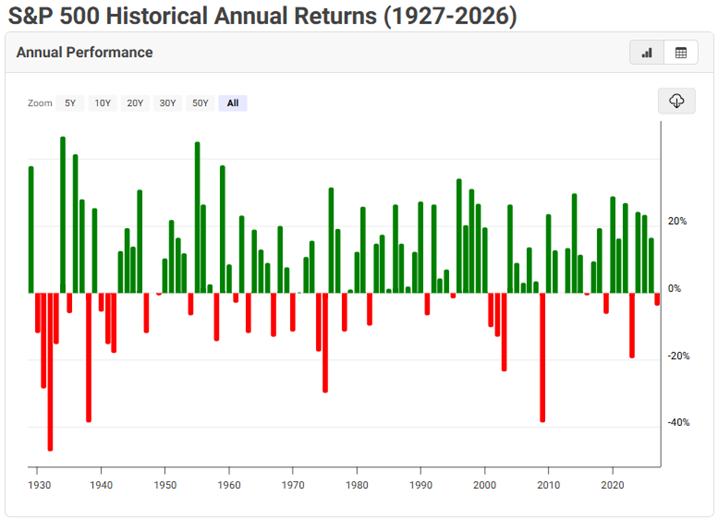
Source: Macrotrends.com
Outlook
In terms of philosophy, this historical momentum continues to reinforce why strategic equity exposure remains essential to long-term capital appreciation, even when markets experience periodic drawdowns.
While downturns are uncomfortable, attempting to avoid them requires being correct twice: when to sell out and when to buy back in. History shows that investors who remain disciplined and invested through periods of volatility are more likely to achieve their long‑term objectives.
Q1 Fixed Income
Fixed income markets were volatile during the quarter, largely driven by changing interest‑rate expectations and heightened geopolitical uncertainty.
The fixed income indices we track produced returns ranging from slightly negative to modestly positive, depending on duration and credit exposure. Our credit‑oriented strategies continued to benefit from attractive starting yields, even as price returns were muted.
Municipal Bonds
Municipal bonds, represented by MUB, outperformed all other fixed income indices through mid-February but fell near the end of the quarter.
This appears to be a result of broader macro uncertainty, but we remind investors that we have been here before – last year. Recent history offers a useful reminder that temporary dislocations can reverse quickly once sentiment stabilizes and fundamentals reassert themselves.
In 2025, the municipal bond index was up roughly 1.5% through February, only to see those returns evaporate in March and April. But as it traditionally does, the market found its footing and delivered a solid calendar-year return of 4.25% in 2025.
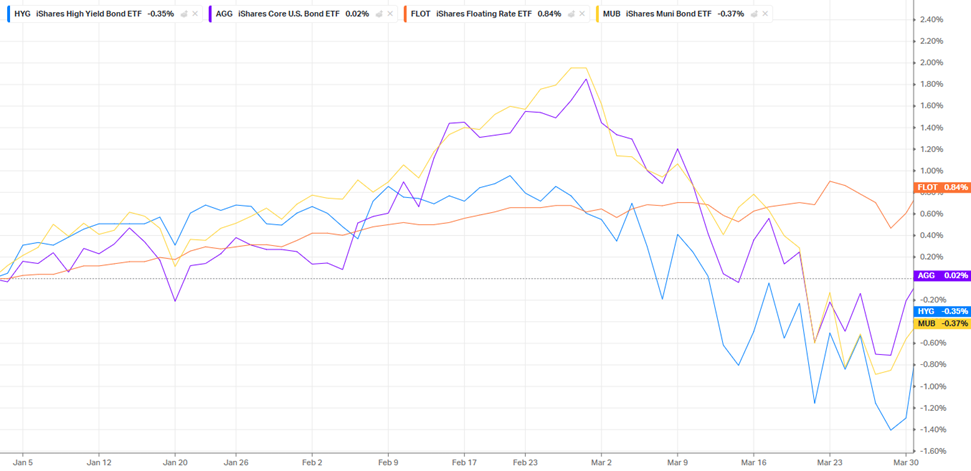
Source: Koyfin; Q1 2026 Time Weighted Returns
Bond Market Trends
Income is expected to be the primary driver of fixed‑income returns in 2026. While interest‑rate volatility led to short‑term price fluctuations during the quarter, yields remain elevated compared to recent history, providing a solid foundation for forward returns.
The yield curve below helps explain the quarter’s bond performance. Compared to the end of 2025, shorter‑term yields moved modestly higher during the quarter as markets reassessed the timing of future rate cuts. Longer‑dated yields also rose, reflecting increased inflation uncertainty tied to energy prices and geopolitical developments.
This movement resulted in modest price pressure across much of the bond market, particularly for longer‑duration bonds. Short‑duration and floating‑rate strategies once again demonstrated their defensive characteristics in a rising‑yield environment.
From an economic standpoint, higher yields do not materially change our longer‑term outlook. Financing costs remain elevated, but income levels across fixed income continue to be compelling relative to cash and historical norms.
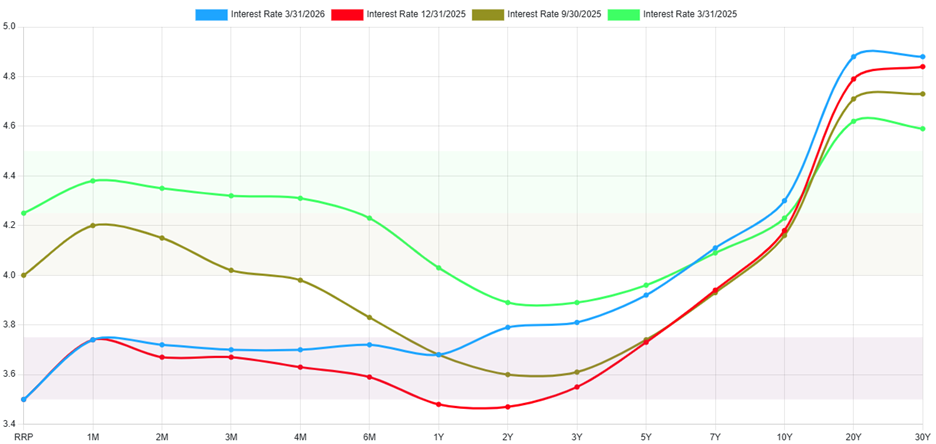
Source: USTreasuryYieldCurve.com; Yield curve by timeframe
Outlook
As always, we remain focused on balancing income, risk, and diversification while positioning portfolios to weather short‑term volatility and participate in long‑term growth.
Q1 Private Equity
Private equity continued to demonstrate its value as a long-term return driver during the first quarter, even as the broader market environment remained uneven.
The secondaries market, which forms a meaningful part of our allocation, remained active and continued to benefit from strong institutional demand. Both LP-led and GP-led transactions saw healthy volumes during the quarter.
These strategies allow managers to acquire mature, often partially de-risked private equity assets at attractive entry points, which we view as a structural advantage relative to blind-pool commitments to new funds.
Buyout deal activity was slower than many had anticipated heading into the year, weighed down by tariff uncertainty, concerns around software valuations, and a more cautious financing environment. That said, the quality of transactions being executed has improved.
Venture capital and growth equity continued to be a tale of two markets. Record funding headlines were driven almost entirely by a small amount of artificial intelligence infrastructure mega-rounds, while the broader ecosystem outside of AI remained slow, with selective fundraising and limited liquidity.
Growth equity fared somewhat better, with M&A picking up as a practical exit path and the secondary market maturing into a genuine liquidity tool for investors in long-dated positions.
The IPO market stayed quiet in the U.S. during Q1, but the pipeline of companies preparing to list continues to grow.
Outlook
We view our exposure to this segment as a long-term opportunity, particularly given that valuations have reset considerably from their 2021 peak.
Q1 Private Credit
Private credit was one of the most discussed asset classes of the quarter, and not always for the right reasons.
A wave of redemption requests at several large non-traded lending funds generated significant press coverage and raised questions about the health of the broader market.
Our message is simple: redemption headlines do not, in our view, point to broad-based impairment across private credit; rather, they underscore how much dispersion now exists beneath the surface.
Market Discipline & Manager Focus
In this environment, underwriting discipline, manager selection, vehicle structure, and liquidity design matter far more than headline yield alone. This recent activity reflects the consequence of a specific set of behaviors during the fundraising boom of recent years, when some managers loosened lending standards and chased higher yields to attract capital. Those managers are now under the most stress. The managers we select prioritize credit quality and underwriting discipline, and they are performing accordingly.
It is also worth noting that the redemption gates which attracted so much attention are not a cause for alarm. They exist to prevent a manager from being forced to sell performing loans at a discount simply because investors want their money back at the same time. The gate protects everyone in the fund, including those who are not redeeming.
Large-cap and upper-middle-market direct lending faced the most pressure during the quarter. This part of the market sits closest to the broadly syndicated loan market, where competition among lenders has been most intense and where the largest redemption events were concentrated.
Spreads compressed significantly over the past two years as new capital flooded in, and some managers in this space made concessions on structure and covenants that are now being tested. Core middle-market direct lending, which targets smaller companies with more conservative loan structures, held up considerably better.
The opportunistic credit exposure we manage is designed for exactly this kind of environment. When parts of the market experience stress and traditional lenders pull back, managers with flexible mandates can step in and provide capital on better terms than they could during more competitive periods.
Dislocation in the broadly syndicated loan market, pressure on software-related credits, and increased sponsor urgency around refinancings are all creating opportunities for disciplined opportunistic lenders.
Collateralized Loan Obligation (CLO)
Collateralized loan obligation (CLO) equity deserves its own discussion because it behaves differently from the rest of our private credit holdings. The leveraged loan market came under meaningful pressure during Q1, driven by concerns around software sector credits, geopolitical uncertainty, and a broader risk-off tone, and our CLO equity position reflected that in its short-term returns.
The underlying loans continue to perform and we maintain a positive sentiment on the long-term return profile of this strategy, but investors should expect it to show more volatility than the rest of the private credit sleeve when markets are unsettled.
Outlook
Despite the noise, we remain confident in private credit as a long-term allocation. The asset class continues to offer yields well above what is available in public fixed income, and the managers we utilize have demonstrated that disciplined underwriting holds up through periods of stress.
The current environment is, in many ways, sorting the market in a healthy direction and separating managers who took appropriate risk from those who did not. We believe our portfolio is on the right side of that divide.
Q1 Real Assets
Real assets remained one of the steadier parts of the allocation. In a quarter defined by energy disruption and renewed inflation sensitivity, real assets continued to demonstrate why they serve a key role in portfolio construction.
Contractual cash flows, inflation-linked revenue streams, and essential-use exposure helped support resilience even as public markets repriced macro uncertainty.
Traditional real estate continued to emphasize long-term leases to creditworthy tenants with rent escalations and solid property-level fundamentals, with annualized distributions outpacing the public fixed income sector.
Private real estate entered the year with positive momentum from recent quarterly returns, driven by steady income and modest appreciation.
Infrastructure also performed in-line with expectations, continuing to provide income while insulated from day-to-day public market volatility. This asset class has shown resilience as cash flows are dually regulated or contracted and inflation-linked.
Income, contractual escalators, and exposure to sectors with healthier underlying demand attributed to the positive returns of the asset class. Conversely, interest rates stayed high enough to keep valuation pressure on more rate-sensitive assets, and public market volatility created noise even where private operating fundamentals remained sound.
Outlook
We still believe real assets are built for long-term appreciation with real estate fundamentals improving as supply slows and industrial and multifamily demand stay firm, while infrastructure continues to benefit from multi-channel cash flows.
Key Takeaways
Periods like the first quarter are a useful reminder that long-term wealth is not preserved by reacting to every headline, but by owning durable assets, maintaining appropriate liquidity, and remaining disciplined when volatility rises.
We continue to view the strongest portfolios as complementary components of a thoughtful long-term allocation rather than competing short-term trades.
Our focus remains on disciplined construction, rigorous manager selection, and thoughtful risk management so capital is positioned not only to withstand uncertainty, but also to benefit from the opportunities that dislocation can create over time.
Disclosure: Past performance is not a guarantee of future results. Indices and/or ETFs tracking indices referenced are presented for informational purposes only, and do not constitute advice to purchase or sell any securities. It is not possible to invest directly in an index, and indices do not reflect the deduction of any fees or expenses. No advice is given with respect to any investors' unique circumstances. Commentary provided is based on observation and analysis of macroeconomic conditions and is intended for educational purposes only.